HAROLD’S PARK
THE FARM
Through maps and other sources we can get an idea of how Harold’s Park Farm evolved in the century before the arrival of John Mackie in 1953.
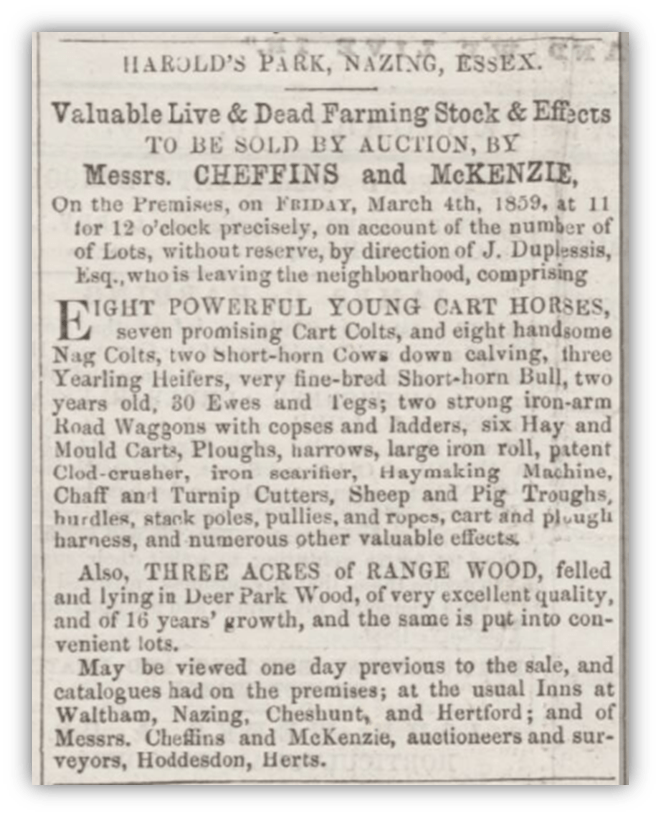
In several newspapers early in 1859 Jules Duplessis advertised an auction of his stock because he was ‘leaving the neighbourhood’.
In the period of ‘high farming’ between 1850 and 1875, British agriculture was more prosperous than ever before or since. Farm machinery like that offered by Duplessis helped increase yield. It was on display at the Great Exhibitions of 1851 and 1862, and in contemporary catalogues which featured dozens of machines like those below.
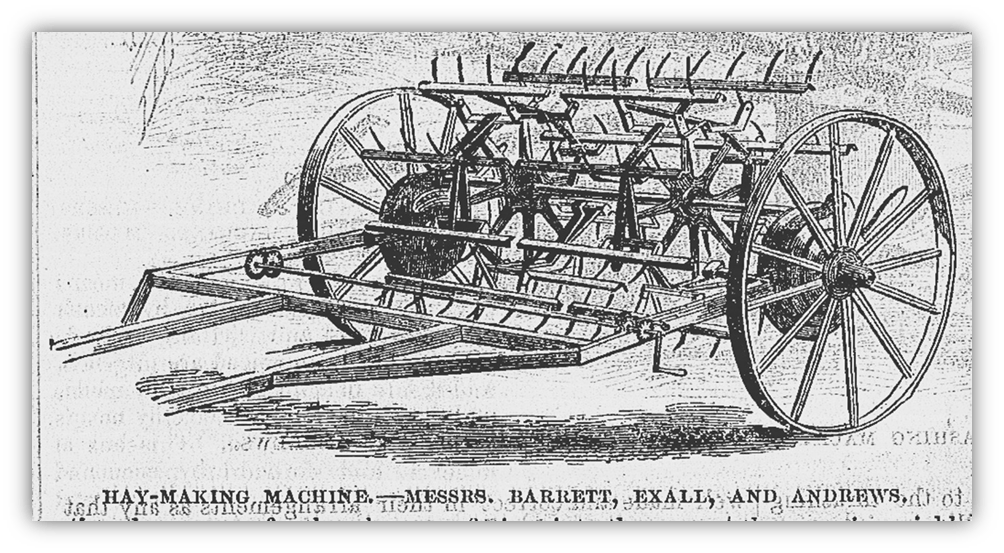
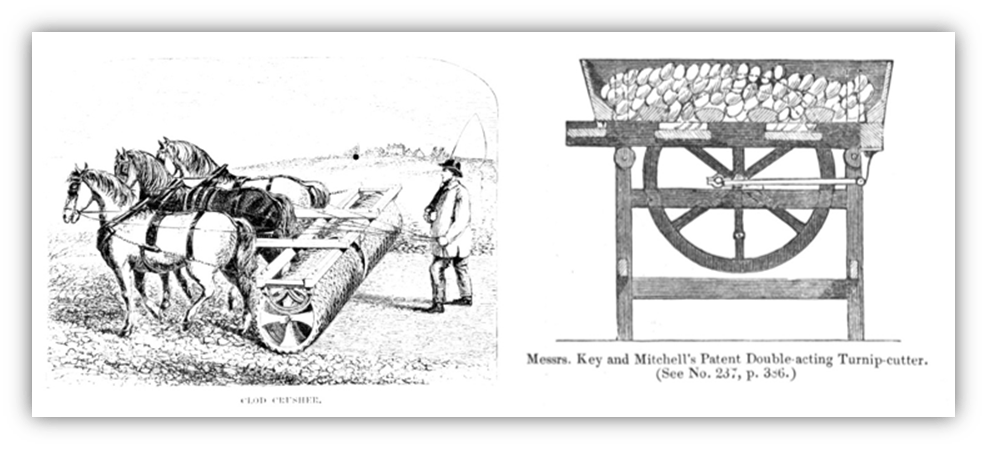
The clod-crusher (left) would have especially useful on Nazeing’s heavy clay soil.
From: http://www.foodheritage-berwick.org.uk/Local_Food_Past/Galleries/1862/index.html
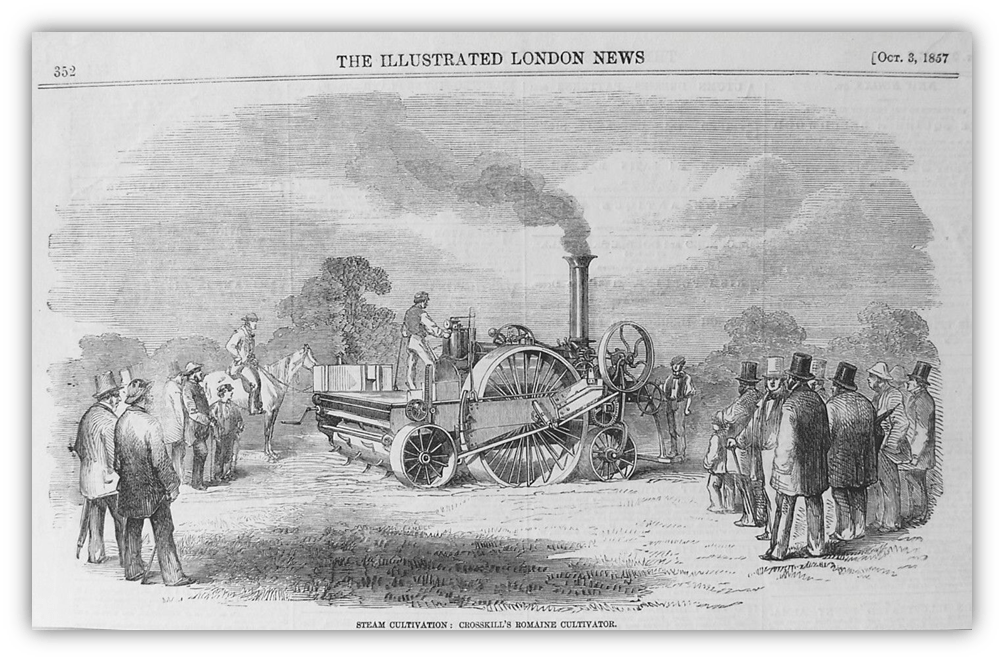
In 1871 a steam cultivator was brought on to Harold’s Park Farm – an event that was still remembered 36 years later by the witnesses at Palmer v Guadagni (see below).
The change from arable to pasture
In 1847 Harold’s Park was a mixed farm with over 40% arable. This probably did not change in the quarter-century of high farming, when arable farming reached its peak, although by the time William Graham arrived in 1886 a further 35 acres had been laid to grass. Graham was primarily a dairy farmer and in 1918 only 54 acres of arable remained. Then, as part of the government’s war time drive for increased food production, a different 31 acres of pasture in the parish of Waltham Holy Cross (fields 65 and 153 next to Deer Park Wood) were ‘ploughed under D.O.R.A.’ [Defence of the Realm Act] on the instructions of the Essex War Agricultural Committee.

This map and the accompanying survey were created for the sale of Harold’s Park Farm in 1920. They showed the state of the farm in 1886, with notes of changes made by the tenant, William Graham. The schedule listed every piece of land on the farm. There were 349 acres of pasture, 86 acres of arable land, 73 acres of woods and spinneys, and 4 acres occupied by the buildings.
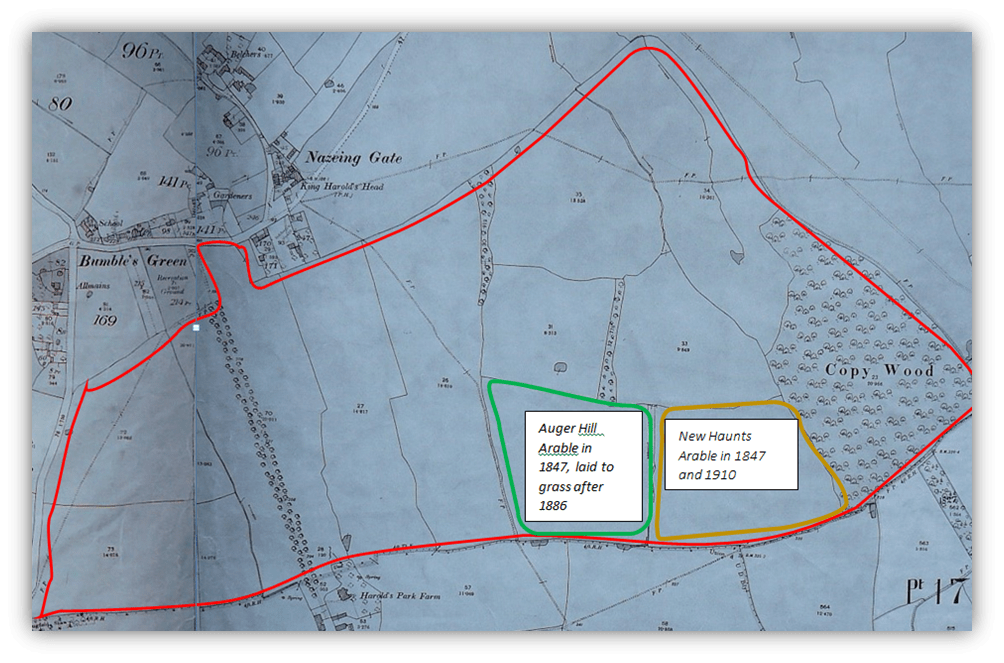
In the portion of the farm in Nazeing, outlined in red, the 14-acre New Haunts was by 1912 the only remaining arable field. There were 143 acres of pasture, of which 13½ acres called Auger Hill or Angus Field had been ‘laid since 1886’ from arable. Copy Wood was 21 acres, and two spinneys were just under an acre each.
Great Football Field and Little Football Field
In 2005 academics from the University of Essex did some research into the use before 1800 of the name ‘Football Field’ in the county. Among their findings were that such fields were often situated on the edge of a parish close to a main road, and flat and rectangular in shape, much like a modern football field. Both of these apply in Nazeing where the two fields were probably one before the creation of the Avenue, so it is likely that they were used for football in the eighteenth century. Remarkably, older residents remember football being played on Great Football Field in the 1950s, so the game may have been played there almost uninterrupted for over two centuries. Little Football Field became part of the Lower Recreation Ground and is now the home of Nazeing FC. In 1962 John Mackie gifted 8½ acres to Nazeing Parish Council to enlarge the Recreation Ground and make it possible to play football there.
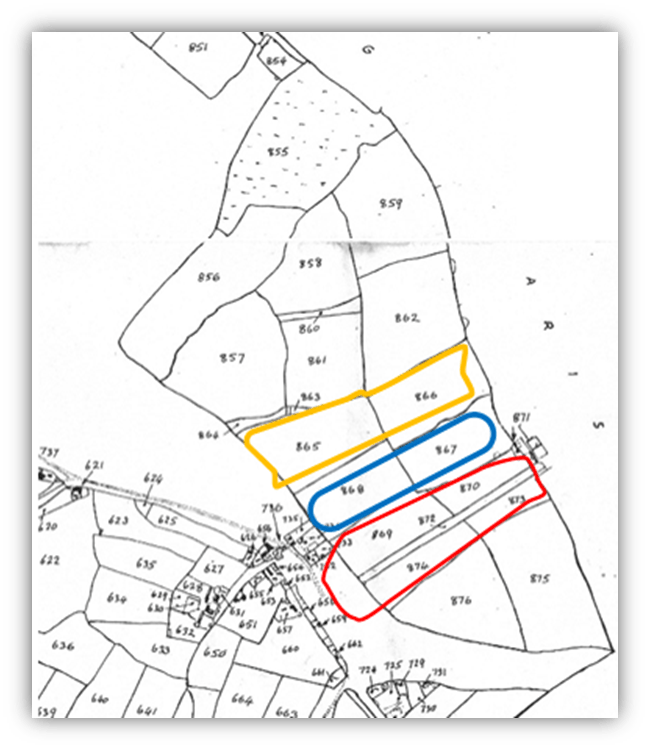
Under the 1858 Enclosure Award, Harold’s Park acquired almost two acres of waste. They were combined with Great Football Field (869), Little Football Field (874), Great Hogscote (870) and Little Hogscote (873) to form a meadow of just over 20 acres, divided by the avenue. These larger meadows are outlined in red on the map.
By 1920 two more pairs of grass fields had been combined. Pound Field or Hill (868) and Cow House Hill (867), shown in blue, made one large meadow of nearly 15 acres. The Nine Acres (865) and Bush Hill (866), shown in yellow were almost 19 acres.
Palmer v Guadagni, 1907
The case of Palmer v Guadagni came before Mr Justice Swinfen Eady at the High Court on 17-20 July 1907 and the two sides called witnesses to establish whether or not there was a custom of carting on the Common.
An important asset on the farm was the timber of Copy Wood, which Graham carted across Nazeingwood Common. He had since 1894 been using gates from Pound Field, Nine Acres Field and the two Copy Fields, all of which bordered the common (nos. 868, 865, 856 and 857 on the tithe map). This displeased the Common Trustees whose chairman, Ralph Palmer, wrote to Graham, warning him that his ‘action in crossing the Common with carts was a trespass which the Trustees would not further permit’. Guitto Guadagni asserted through his agent, Cecil Hunter, that ‘there was no other way of getting timber from The Copse [Copy Wood] and the owner had always had a right to cart it through one of the Common Gates’
The evidence is of great interest, and mostly confirms what we know from other sources. The witnesses paint a picture of a farm largely dependent on its hay crop. If the labourers could get away with it, they carted the hay across the Common; if not, they carried it truss by truss – memorably, in the case of George King, on his head!
Charles Bridgeman, a hay dealer from Curringtons Farm, said that three times a week he used his van to bring two hayricks from Harold’s Park Farm as they stood. Altogether he bought 30 loads of hay and carted it to London at 50s per load. He does not say how much of this was profit but it was certainly a substantial amount of money. ‘I would not have bought the hay if I could not have crossed the Common,’ he stated. Isaac Hale of Shadwalkers carted nine loads of hay a week.
The judge found that the defendants had a good case over Copy Wood, but rejected their claims to the right of carting from the fields. The Trustees won £3 13s 8d in damages but it was a pyrrhic victory, because each side was to bear its own costs. Theirs totalled £439 16s – a debt which took twenty years to clear. Guadagni must have had similar expenses which may have contributed to his mortgaging and then selling the property.
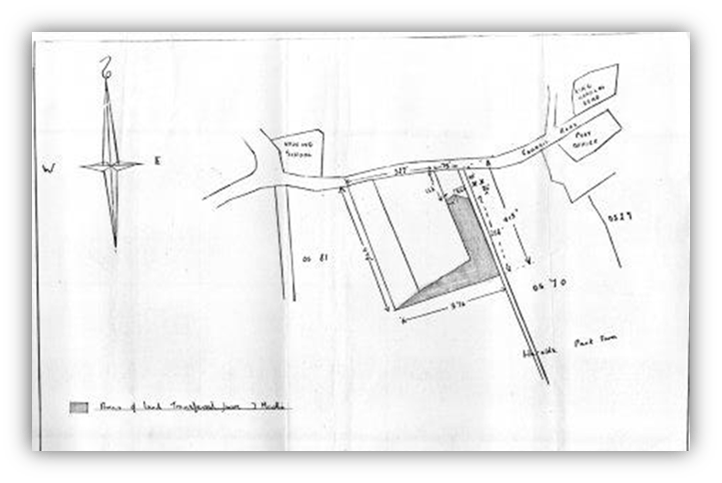
In 1962 john Mackie gifted 8 1/2 acres (shaded on map) to Nazeing Parish Council to enlarge the Recreation Ground and make it possible to play football there.
If you have enjoyed reading these snippets of history get in touch and we will send you the longer version.
David Pracy 2025
 Nazeing History