PEACE AT LAST
The war had begun on 1st September 1939, when Adolf Hitler launched his invasion of Poland. Britain and France declared war on Germany 2 days later on the 3rd September. The following spring, May 1940, the Germans attacked Belgium, the Netherlands and France, who surrendered in June. Then Hitler turned his sights on England and the Battle of Britain was fought in the skies above Southern England from July to September. There were 6 months of the Blitz when London was bombed nightly during October and November. Nazeing suffered greatly during this time. Then followed a period when the war became truly global.
It was not until 6th June 1944, D-Day, when the invasion and liberation of North West Europe began, that any hope for peace could truly be seen. It would be nearly a year before the German High Command signed the surrender of all their forces in Europe. Winston Churchill made his famous speech on radio on the afternoon of May 8th 1945.
VE Day, 8th May 1945
The people of Nazeing, just like everywhere else in the country celebrated V E Day, although the war still continued in the far east.
There was a party in The Tin Tabernacle in Betts Lane. This was the church hall situated opposite Buttfield, the house just visible in the background of the picture. The church hall had previously been marked as a reading room in earlier O.S. Maps. It continued to be used, especially by the Upper Nazeing Women’s Institute, until it was demolished in about 1960.
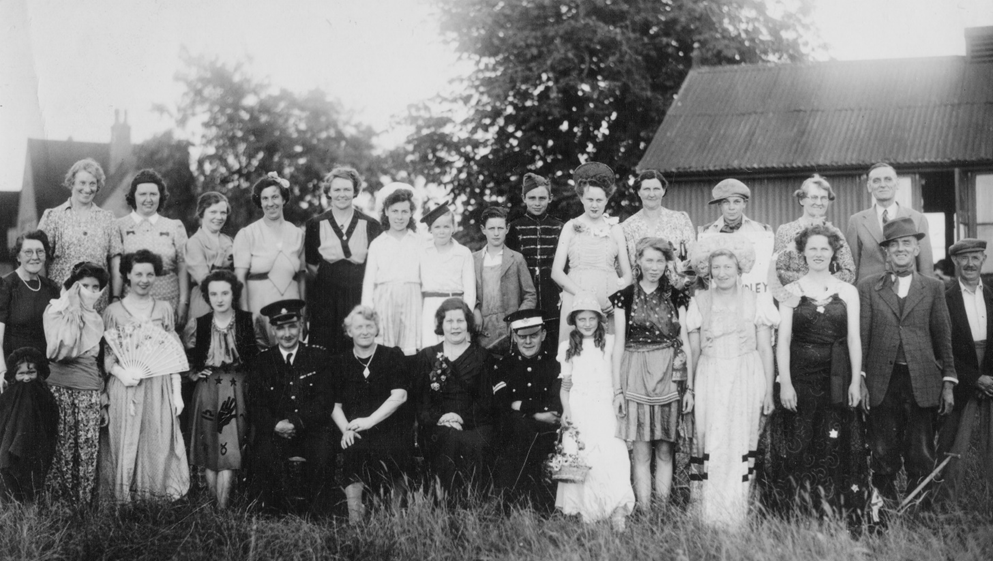
Can you name any of these revellers from 1945? We know many, but not all of them. Far left is Emily Mead, with glasses and pearl necklace, postmistress from Bumbles Green. Far right, back row, is Foxy Reynolds and his wife who lived at Church Cottage. We met them in the last post, they hosted a Land Army girl.
The photo below is from the inside of the Church Hall (Tin Tabernacle) in Betts Lane – a fancy dress party with John Welch dressed as Mickey Mouse. John would work as a mechanic for all his working life, initially with his father Andrew, at Welch’s garage in Bumbles Green. His mother Louie, is seated behind him to his right in the football shirt.

Revellers celebrating at the end of the war. Many young men are still away at war. Are any of your family here, we would love to know? We have a few names, but not all of them. Please contact us on https://www.facebook.com/nazeinghistoryworkshop or this website’s contact page https://nazeinghistory.org/contact if you recognise anyone.
Bumbles Green held a street tea party for the children, who we can see here gathered together in Almains Close.
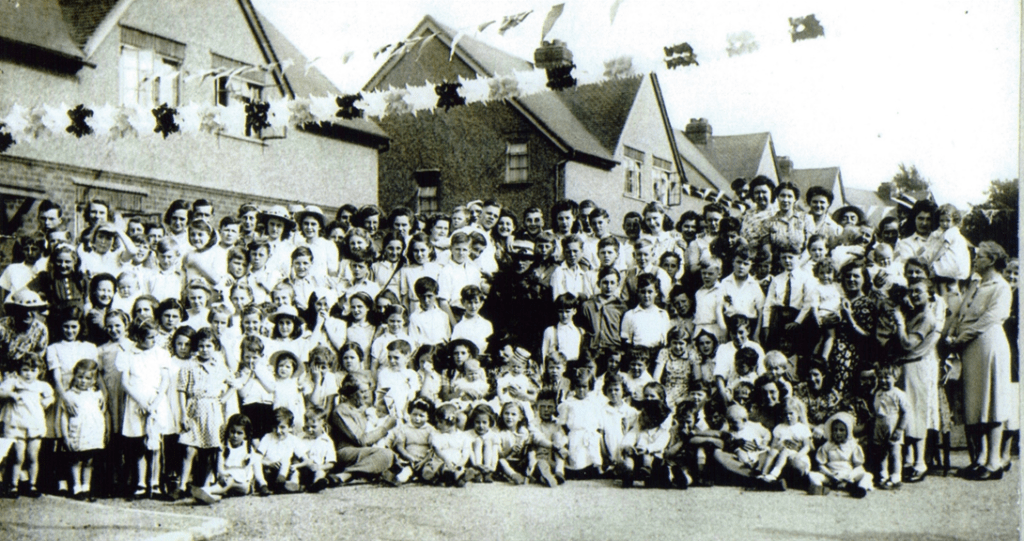
All the children from the Bumbles Green area on VE day 1945
Irene Johnson told the History Workshop: I joined in the street party to have a bit of fun with my friends. I mean they were giving away free food and drink, so we all thought we would join in with that. I was 18 at the time and this was supposed to be a children’s party [for five to 15 year olds], but I don’t suppose they minded, it was just a bit of fun. The clown, in the centre, who entertained the children, was George Judd. George lived and grew up in Belchers Lane, Bumbles Green. With his son Ken, his business provided plumbing services throughout the village and beyond.
The Lower Nazeing children’s party was held in the cadet hut by the mini cross roads in the “Tudor Village”, as it was known then. We now know it as the junction between Western Road and Highland Road. Each child was asked to bring their own cup and plate, which you can see if you look closely at this group photo.
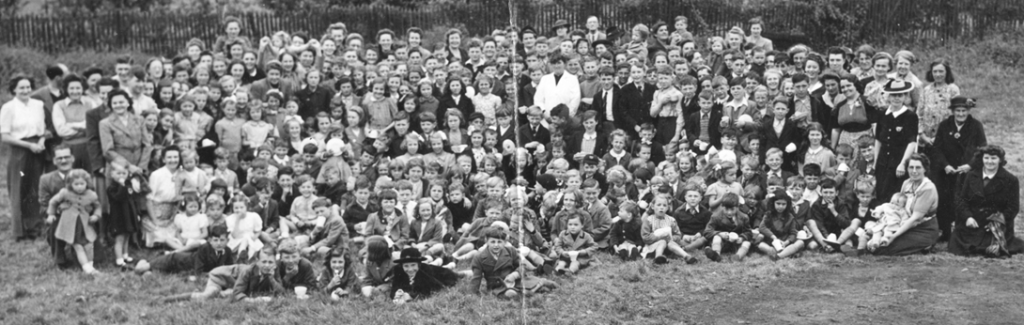
The children all gathered in together near the cadet hut in Lower Nazeing. Can you spot your family members?
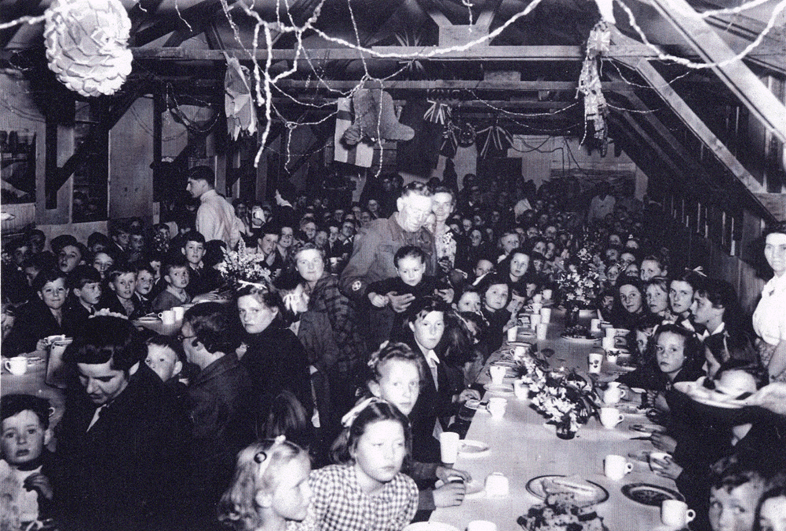
All squeezed into the cadet hut for a special celebration tea
V J Day 15th August 1945
On 6th August, the United States dropped the first atomic bomb over Hiroshima, ultimately killing as many as 140,000 people, followed by another on Nagasaki three days later. Japan surrendered unconditionally on 14th August 1945.
In the U.K. Victory over Japan was commemorated on the 15th August 1945. It marked the end of almost 6 years of global conflict.
The photo below shows the adults with their own celebratory event in Nursery Road, near to the aerodrome. Can you name any of these villagers celebrating the end of the war? Contact us on facebook https://www.facebook.com/nazeinghistoryworkshop or this website’s contact page https://nazeinghistory.org/contact
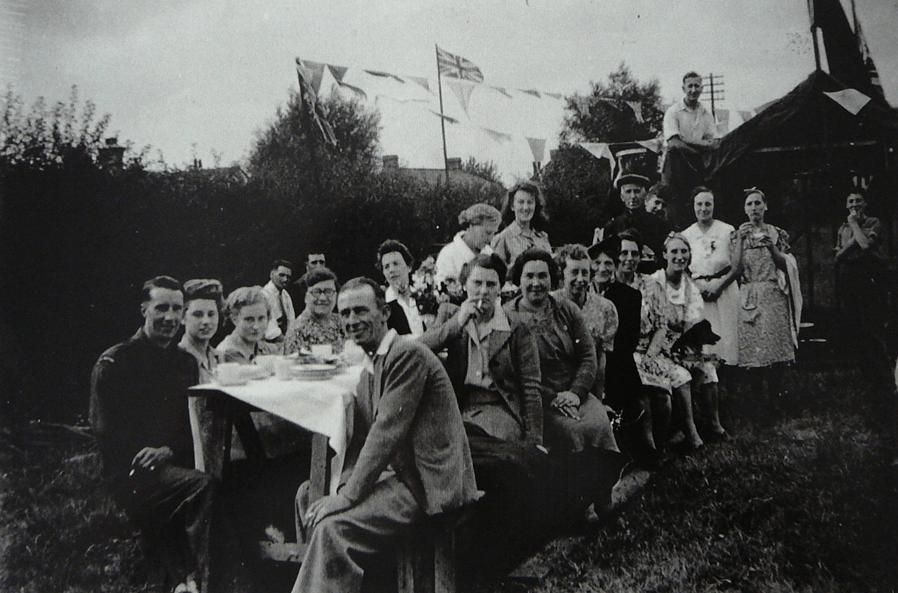
Peace at last, celebrating in Nursery Road, photo donated by Doris Cook
Welcome Home
As in many other towns and villages Nazeing had a Welcome Home Fund, which would have been registered with the county council. It was led by the Rev. Sutherland as chairman, a list of those on the committee can be seen below.
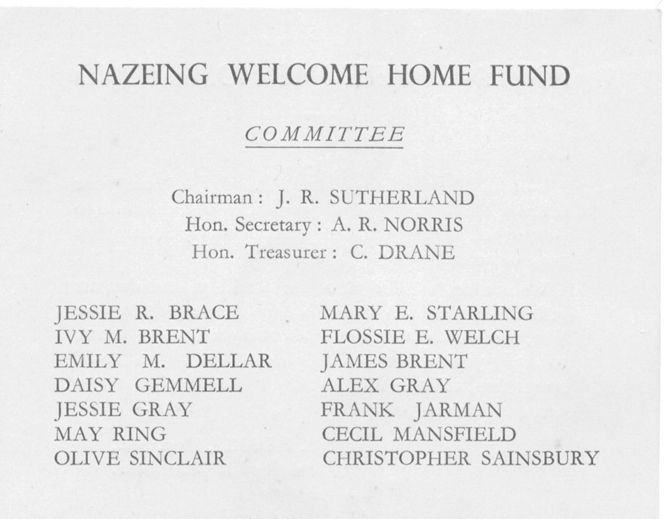
The members of the committee of the Welcome Home Fund
This card (below) was received by Dennis Mead in 1946, and presumably by all those who served their country. Does any one know what the gift was?
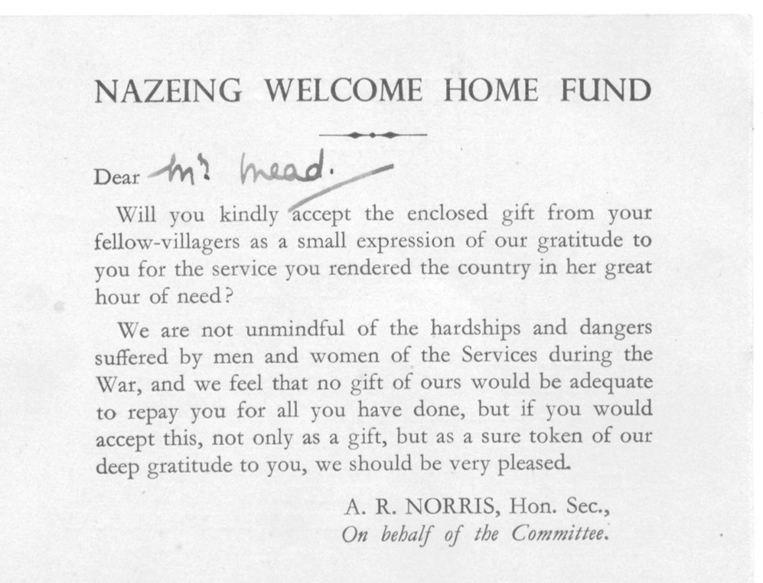
Back to Normal?
The end of the war didn’t mean everything would go back as it was before. There had been many shortages of food and other consumables. Not that villagers in 1945 consumed much. It had been “make do and mend” for many years. Every garden, however small, had a vegetable plot. Many kept a few chickens for their eggs, which were fed on peelings and other kitchen waste. During the war, food and other commodities were rationed, and everyone had a ration book. This helped to ensure even the less well off had access to food and helped to prevent the supply of food being exploited for profit. Below shows Harry Mead’s Ration Book. He lived at Cranbourne Cottages in Bumbles Green, at the house which had previously been the Post Office. The book tells us where they went for their provisions and exactly when different foods ceased to be rationed and were more freely available.
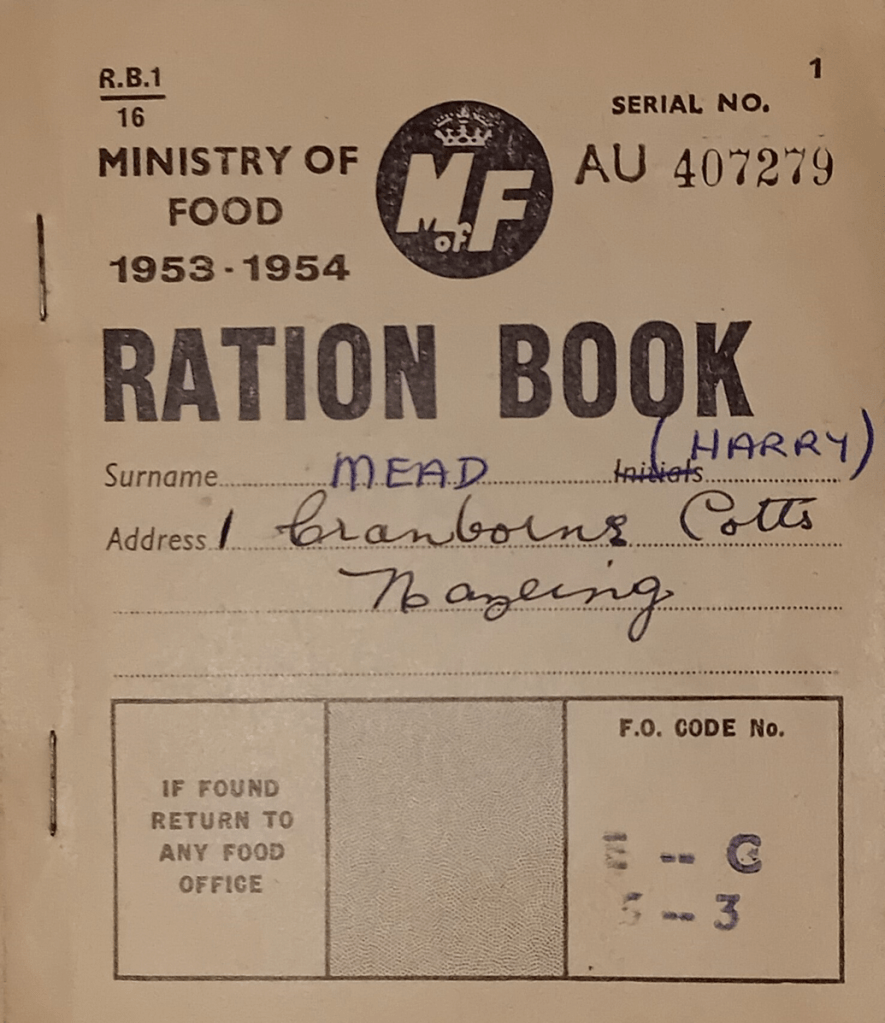
You can learn about Harry and his family in A Purely Agricultural Parish? available via https://nazeinghistory.org/publications or contact us via https://www.facebook.com/nazeinghistoryworkshop for your copy at just £10 + P&P, also available at the Waltham Abbey museum.
It is a well-remembered fact, by the older generation, that sweets came off rationing on 5th February 1953. But what about other items? Harry’s wife Emily recorded in her ration book that meat rationing ended on 3rd July 1954. Their meat had been supplied by Gutteridge of Sun Street, and it may well have been delivered to Bumbles Green. According to the records in the ration book eggs were already off ration by May 1953. Bacon and fats were provided by Pelling’s of Sun Street Waltham Abbey. Bacon, still on ration in May 1954, fats (presumably butter and lard) came off ration in February 1954. Sugar and cheese came from the local shop in Bumbles Green run by Jimmy and Ivy Brent. They came off ration a little earlier, sugar in October 1953, cheese in February 1954.
Food rationing in the UK officially ended on July 4, 1954, at midnight, marking the end of 14 years of food restrictions. This included the final de-rationing of meat and bacon. While the war ended in 1945, rationing continued due to the difficult economic conditions and the need to ensure the fair distribution of available food and other commodities. The utility furniture scheme carried on until 1952, through seven years of post-war austerity. The new range of “utility furniture” in 1942 was to create items that were soundly constructed, in a “simple but agreeable” design, at a reasonable price. The manufacture of civilian furniture was prohibited, except under licence. Those licences were only granted for the production of utility goods. Who remembers furniture like this tallboy from their childhood?

Utility furniture from the 1950s
Clothing was also rationed. During the war years parachute silk, when found (this is an interesting story in itself! BBC – WW2 People’s War – Miles of string and Parachute clothes) was a prized acquisition and was used to make underwear. Only the very luckiest post war bride had a white wedding dress made from this silk. Ration coupons had to be saved up for a new outfit for that special day.
Connie Hale, who we met in the last blog on Land Girls, left the Land Army and went to work in a factory for about 6 months, making ping pong balls and toothbrushes, to get some money for her new outfit. She couldn’t afford new shoes. Her husband to be, Dennis, bought them for her. They cost more than the hat and dress; she treasured them for many years. Dennis was in his Royal Air Force Volunteer Reserve uniform; it would be another six months before he was demobbed and returned home to Nazeing.
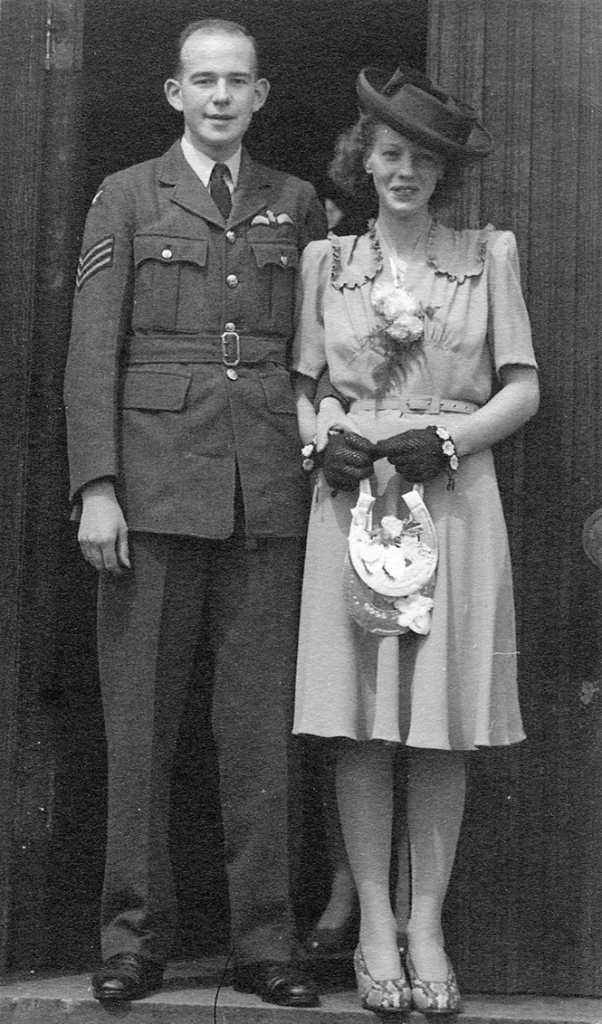
Dennis Mead and his wife Connie at their wedding in 1946
United in Peace
At the end of the war the combined civil defence groups, and the church choir were pictured standing outside the Lychgate at All Saints Church in Betts Lane, presumably after a service of thanksgiving to the long-awaited peace. At that time the stables and other outbuildings associated with the vicarage can be seen on the right had side of the photo. They were demolished and the New Vicarage, Nazeby and the car park were built around 1960. Church Cottage, which was discussed in our last blog, is on the left of the photo.
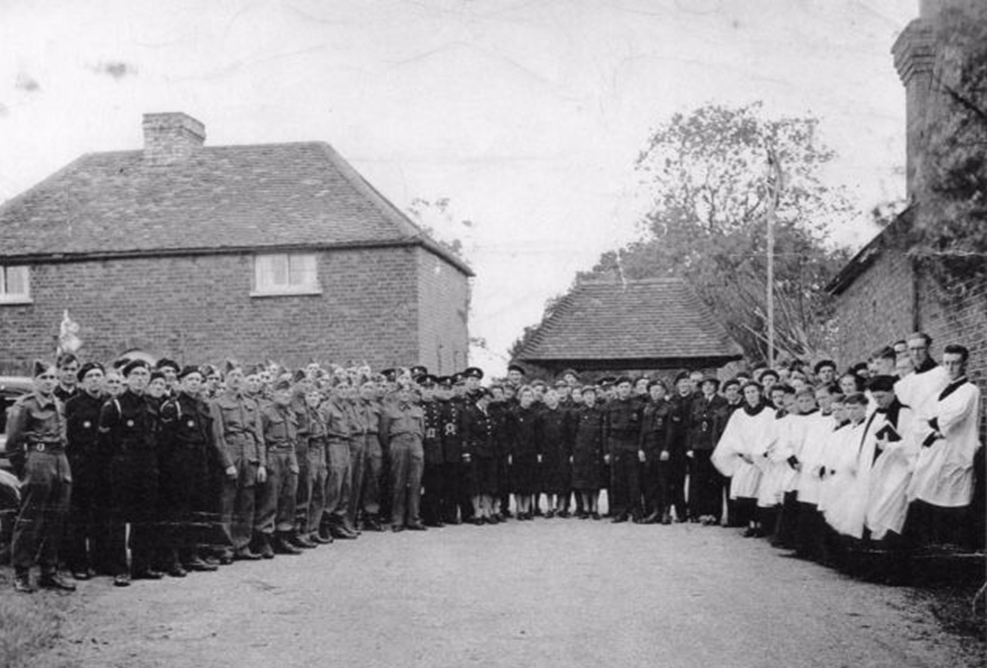
Civil Defence groups and the choir standing outside All Saints Nazeing Church in Betts Lane
The vicar, Rev Sutherland, recorded a list of bombs, making clear, however, how fortunate the parish was to be served by Civil Defence Forces whose keenness and efficiency were acknowledges by all whose devotion to duty did much to comfort and cheer our people in time of danger.
The people of our village with most commendable patience and fortitude braved bombs, flying bombs and rockets and carried on with their work undaunted and undismayed.
We hope you have enjoyed our posts about life in Nazeing during the war years, as well as learning about those people who came before us. To continue to research and record the history of the village we need your help. Please send any information you have about your family in the village so we can record, save and share it with future generations. Do get in touch, via facebook https://www.facebook.com/nazeinghistoryworkshop or this website’s contact page https://nazeinghistory.org/contact
As these blogs about Nazeing at War have been so well received, we hope to continue with regular posts in the future, so do keep an eye out for more about the History of Nazeing.
Jacky Cooper – July 2025
 Nazeing History