LOCALS, INCOMERS AND SETTLERS: NAZEING’S WAR COMMUNITY
The Women’s Land Army
The Women’s Land Army was set up in World War 1 and reformed in 1939. At its peak in Britain in 1944, over 80,000 women, known as Land Girls replaced male farm and nursery workers who had gone to war from June 1939 until November 1950. Phyllis Charman from Romford signed up in April 1942.
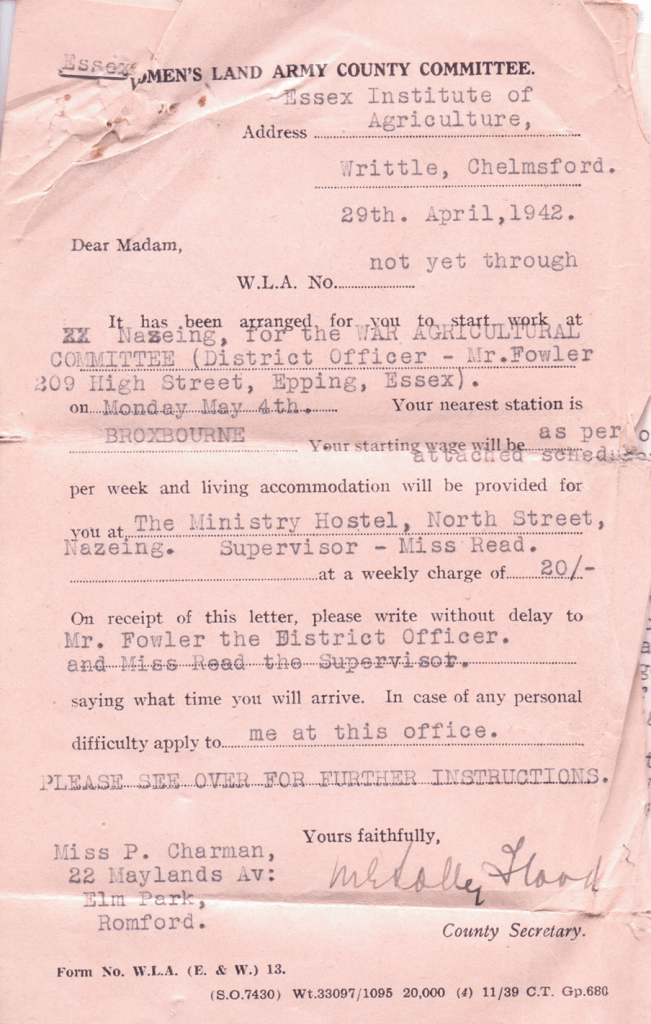
Letter sent to Phyllis Charman after she signed up for the Women’s Land Army
Phyllis was sent to Nazeing and received her train ticket and the following table of minimum wages paid by the Essex County Committee of the Women’s Land Army.
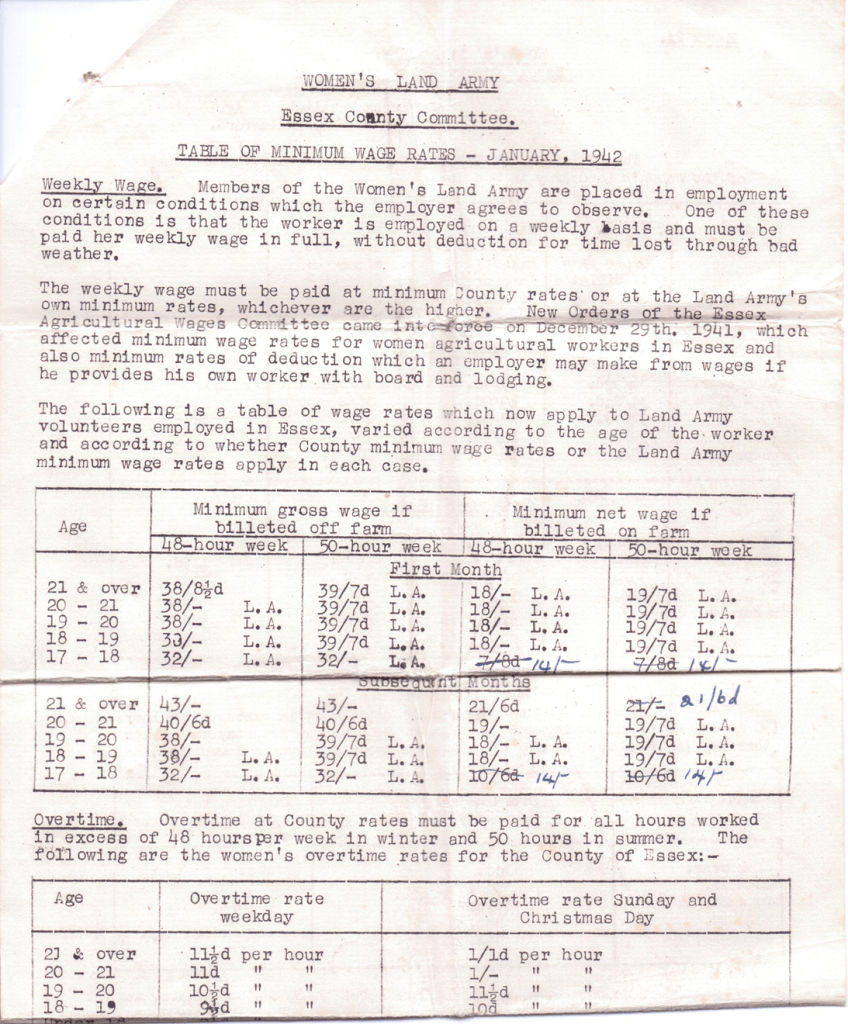
Minimum Wages for Land Army Girls in Essex in 1942
As you can see, Phylis was charged twenty shillings a week from her wages, listed above, for her accommodation at the hostel in Nazeing. That left her with just twelve shillings a week. Agricultural wages at this time were over Forty Shillings, that is Two Pounds.
We know that at least one Nazeing girl joined the Women’s Land Army, – Lucy Andrew, featured below – but most of those that replaced the agricultural workforce, farm hands that had gone to war, were from towns in the south east, including the London boroughs.
LANGRIDGE FARM

Langridge Farm in 1940
Between 1940 and 1949 seven Land Girls helped Willis Chapman to run his 584 acres which included Langridge Farm and land on two farms in the neighbouring parish. Some stayed only a few months and others were there for the entire duration of WW2 and many became close friends of the Chapman family for the rest of their lives. Some came straight from school. In January 1943 at a Meeting of the Waltham Abbey Branch of The National Farmers Union, Willis Chapman complained that Land Girls were arriving at the Farm with no training whatsoever; his words being absolutely green girls being dumped on the farms and a resolution was passed to make representation to the proper authorities to ensure Land Girls received some training before being posted to Farms. But in practice, nothing much changed, the girls learnt as they went along.
Lucy Andrew, aged 20 years, lived in Betts Lane and was a Land Girl at Langridge Farm in the summer of 1940, cycling the 5 miles to the farm. She joined the Land Army in 1939 and trained at the Institute of Agriculture as a tractor driver. She worked in the fields and drove the manure carts and hay rake. She left the farm and went on to do a degree in dairying at Reading University. Joan Ashby, from Mayflower in Middle Street, also worked on the farm but wasn’t actually a Land Girl.
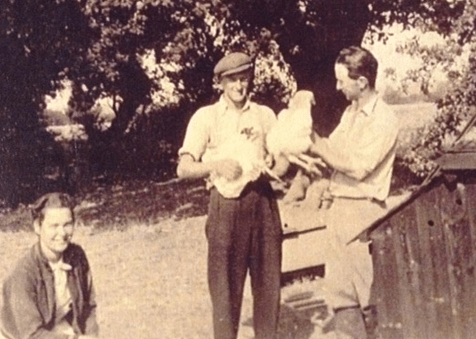
Lucy Andrew with fellow farm workers Roger Hill and Wilfred Castle with young pullets 28th August 1940
Barbara Murray worked at Langridge during the war. Later, as Mrs McGaughay, she brought up her family in Hyde Mead. She continued to work the land throughout her life and was often seen driving a tractor through the village.
Hazel Spear went straight from school at Woodford High School to join the Women’s Land Army and was taken on at Langridge Farm in 1940, where she stayed for the duration of the war. At first, she lived in the farmhouse but later moved into a cottage in Black Adder Row in Nazeing; then she moved to digs in St Michaels Road Broxbourne and also for a time shared a damp caravan with Joan Ashby by the River Lea near The Crown Public House. They had a Tilley lamp for light and heat and were constantly troubled by rats both in and out of the caravan. At the end of the day Hazel and fellow Land Girl Mavis Gill loaded up the milk churns onto a cart, harnessed up one of the horses and took them to the end of Paynes Lane to be collected by the Co-op. She helped collect 400 eggs a day from the Free Range Hens. As they hoed cabbages and cauliflowers they sang and talked of their hopes for the future after the war.
Crops and cattle
The Land Girls were indispensable during the difficult war years, cheerfully taking on a variety of tasks on the farm. There were 146 head of Dairy Cattle on 379 acres of grass; a poultry unit with 6000 hens. Farming 130 acres of oats and wheat needed heavy horses to work the land. A total of 22 staff were needed altogether.
The large vegetable patch close to the farmhouse growing runner beans, peas, strawberries, leeks, onions, sprouting broccoli etc kept the farmhouse supplied along with their own eggs, poultry, milk and potatoes, alongside tomatoes and cucumbers from Willis’s father and brother just up the road at Langridge Nursery. The garden also had plum, apple and pear trees and red and blackcurrant bushes. Extra crops had to be grown to help the War effort and Langridge grew cauliflowers, cabbages and later in the War, flax and sugar beet. In 1941 Willis Chapman bought a Fordson Tractor to support these additional farming demands- a step towards progress. But equally, and sadly, it was also the beginning of the end for the horses on the Farm.
At Langridge, the Land Girls worked from 6.a.m until 5.p.m. for £1.7s 6d a week plus 6d an hour overtime mainly during harvesting. They had a half day off each week but could work 7 whole days for 4 weeks and then were owed 2 whole days off to go home. Their first job in the morning was to light a wood fired boiler to provide steam for sterilising milking utensils. Later in the day, after the milking, they would harness up one of the horses, load up the milk churns and drive the cart to the end of Paynes Lane for the Co-op to collect the churns.
The Land Girls planted cabbages with a cabbage planting machine and later worked in rows, singing as they hoed them. Winter brought its challenges. In freezing weather, the unpleasant jobs included picking the cabbages or brussels sprouts with bare hands with icy water running up their sleeves.
Summer time harvesting was a complete contrast: pleasant weather for outdoor tasks meant the work was enjoyed by everyone, all non-essential jobs stopped when the steam driven threshing machine arrived, and the girls stood on the stacks throwing the sheaves into the machine with their trousers tied below their knees with string to stop the mice running up their legs! They all had fun treading the delivered hop grains for feeding the cows. The grains were hot and were pressed into tins by the girls using their bare feet or wellies.
Some Land Girls lived for a while at Langridge Farm, sleeping on the floor in the hall and going to the cellar with the family when the sirens sounded warning of an imminent attack. Several later went into digs in Nazeing but leaving at 5.30 a.m. for milking at 6 a.m. meant cycling 2 miles in the dark – not everyone’s choice.
The duties of the Land Girls were so varied – they had to be prepared to do any job that needed doing and many of them learnt to drive tractors and other farm machinery. Despite all the difficulties and danger some of the Land Girls recalled that their Land Army Days were some of the happiest of their lives.
The farm would not have survived without them during the War. There would forever be a debt to these Land Girls who worked so hard for the duration of WW2. Many other farms must have felt the same about their land girls.
The BBC WW2 People’s War web site has been a good source of stories. Joyce Martin recalled: her mother had a succession of Land Girls as lodgers, one of whom, Renee Baker from Walthamstow, stayed to the end of the war and was very much like an older sister for me.
Gwen Brockway wrote her diary of life during the war. Her daughter posted it on the BBC WW2 People’s War.
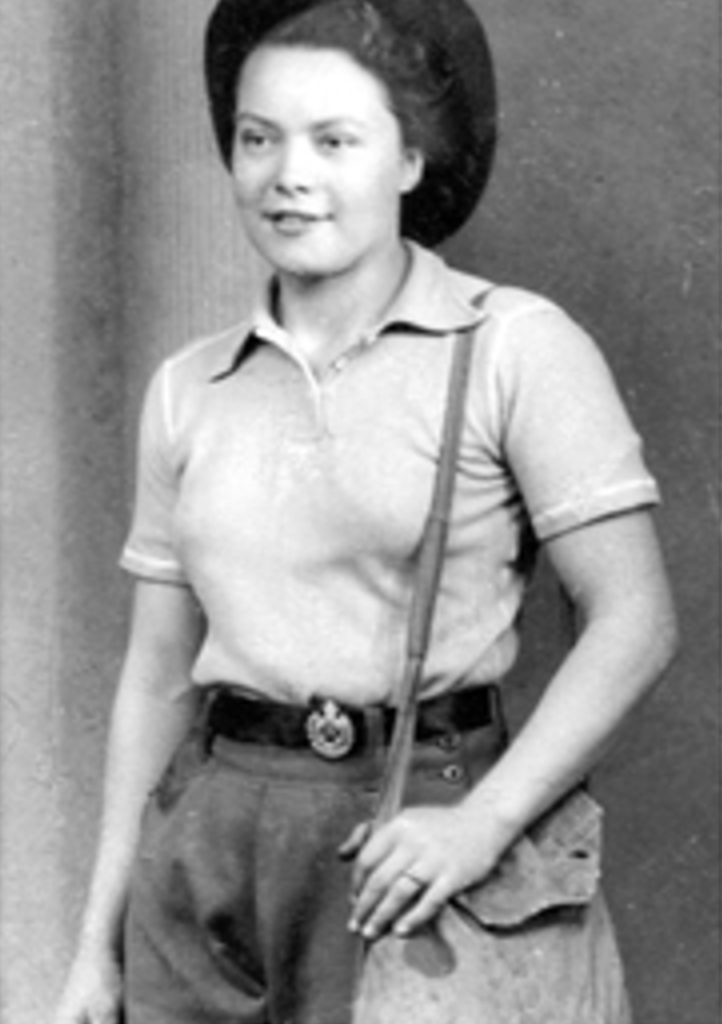
Gwen Brockway
Gwen was born in 1920 in Billericay, became a florist, then joined the Women’s Land Army. She worked in a nursery owned by Mr Lawrence in Broadley Common. Her story illustrates what life was like at that time. She cycled extremely long distances to see her family and young man on the few hours she wasn’t working.
Gwen was billeted in Nazeing with Mr and Mrs Reynolds, at a cottage by the vicarage.
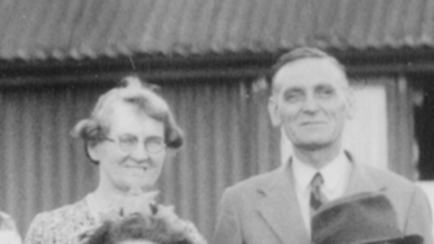
Ma and Foxy Reynolds from Church Cottage at the Tin Tabernacle in Betts Lane
Church Cottage backed on to the churchyard. Mr Reynolds worked for the vicar and was also the gravedigger.
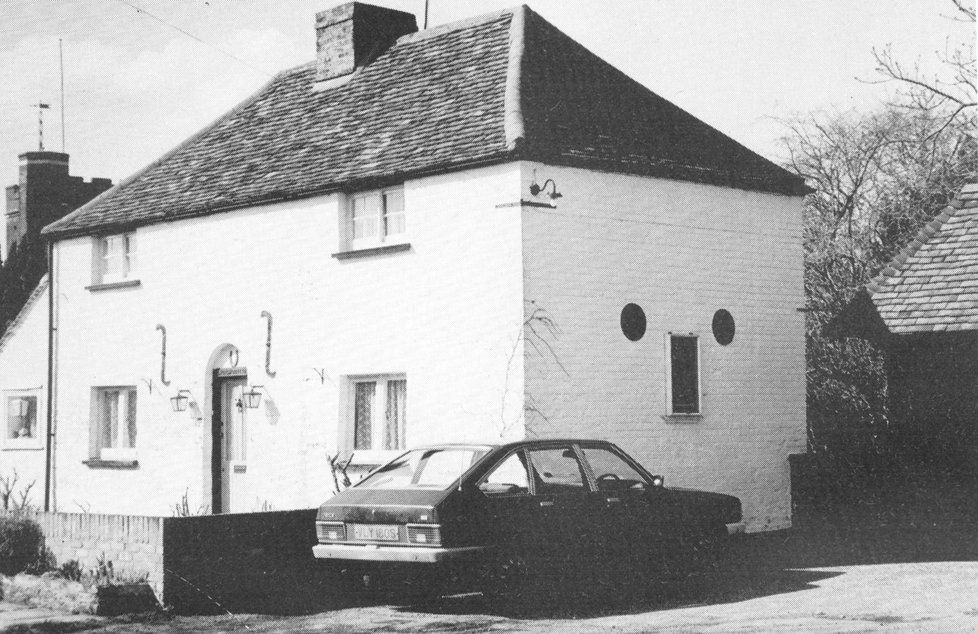
Photo of Church Cottage from 1980
Gwen wrote: The Reynolds had two married daughters, Ella and Winnie, one married son and the youngest Dougie, who was in the navy. The tiny cottage had two small rooms, a sitting room where the door opened onto the winding stairs to the bedrooms. The parlour downstairs that Mr and Mrs Reynolds used as a bedroom and next to the living room was the very tiny scullery. My room was the front upstairs bedroom, the back one looked down on the graves. I loved it there, as it was so quiet. After our evening meal by the light of the fire and candles, Foxy, as Mr Reynolds was known locally, would tell me tales of his adventures in the First World War. When they went to bed Ma Reynolds would leave me a candle to write to Sandy my boyfriend, which was every day. I had to work some Sunday mornings so didn’t have time to cycle home to Billericay. The big rectory set back in the trees had a very large cellar and the vicar said that if any time there was an air raid we were to join him, Mr and Mrs Mansfield and Dorothy there for shelter. It was very comfortable down there, but I hated the thought of that enormous house coming down on top of us. Personally, I preferred to be out in the open during a raid.
Life still went on, as normally as it could. Gwen goes on to tell us about going to a dance in the nearby little village hut, known by locals as the Tin Tabernacle. Dougie was home on a short leave. Being a Saturday night, he asked me to go to a dance at the little village hut, the one near the cottage. I changed into my skirt and black blouse with the gypsy embroidery and we ran across to the little hut. There were some local chaps playing piano and a few other instruments, there were mums and aunties with young girls and some very young children, there were older men past the age of call up. But the boys of the village were missing as they were all in the forces. I walked in with Dougie in his bell-bottoms he was positively swept away from me, no doubt a lot of the girls he had been to school with. I went and sat with the Mums and aunties and watched Dougie having a great time. It must have been the first time I’d been to a dance and just sat and watched. I didn’t mind it was fun seeing the girls in the excuse me trying to get their turn with Dougie. I overheard one of the ladies say to her friend “that young sailor brought that girl in and hasn’t danced with her once, she looks a nice little thing as well.” However, at the last waltz, when the band played the inevitable ‘Whose taking you home tonight, after the dance is through’ Dougie and I had the last dance together.
One evening as we left the vicarage and Mrs Mansfield was waiting to lock up, there was a strange humming, throbbing noise in the sky; it was heavy, yet gentle. It was the sound of many planes possibly Lancasters going towards the East Coast. I thought it was a comforting sound and said to myself ‘come back safely boys’. Mrs Mansfield looked at me as if reading my thoughts and said aloud “Oh, those poor German women and children.” I hadn’t thought of it from that angle. Now there’s a true Christian.
Ma let me use the hipbath up in my bedroom. You can’t get your whole self in a hipbath, or at least I couldn’t, so I dangled my feet in the slop bucket. We had used the enamel slop bucket to take the water upstairs to the bath and when I was ready, I was about to take it one by one down again. To my surprise Ma Reynolds said don’t bother got me to hold one end of the bath and she the other and tipped it straight out of the back window over the graves below. Not quite the thing to do I thought, but very much easier than humping it down those stairs again.
The Agricultural War Hostel in North Street was established in May 1941, and was the first to be opened in Essex. The hostel was converted to a residence named Cedar Lodge after the war. John Elliot Close and the four semi-detached houses named as 88 North Street were built on the plot in the 1970s.
Many of the Land Army Girls at the North Street Hostel had come from London Boroughs. They were given the task of hedging and ditching throughout the parish. Land drainage needed to be maintained with most of the local farm labourers away in the forces.
Connie Hale worked as a dispatch clerk in the city of London until the premises were bombed in the blitz. Her family moved out of the London docks to Chingford and she was then required to do war work in a factory making parachutes for flares. Connie was just 17 years old and not old enough to join the WRAF without her father’s permission, so ran away to join the Land Army. She arrived at the hostel with no training, or uniform!

Connie Hale in her uniform Connie’s Land Army Membership Card
They worked long days and were given slabs of bread to eat for their lunch. Unlike the Land Girls on the farms, due to the nature of their work, the Land Girls at the hostel had weekends off, so could go home to their families. Connie had to ring up home and ask if she could come back for the weekend!
Frank Fitch, a local man managed the team. In the 1939 register he was aged 22 yrs. and working in food production in the glass houses.
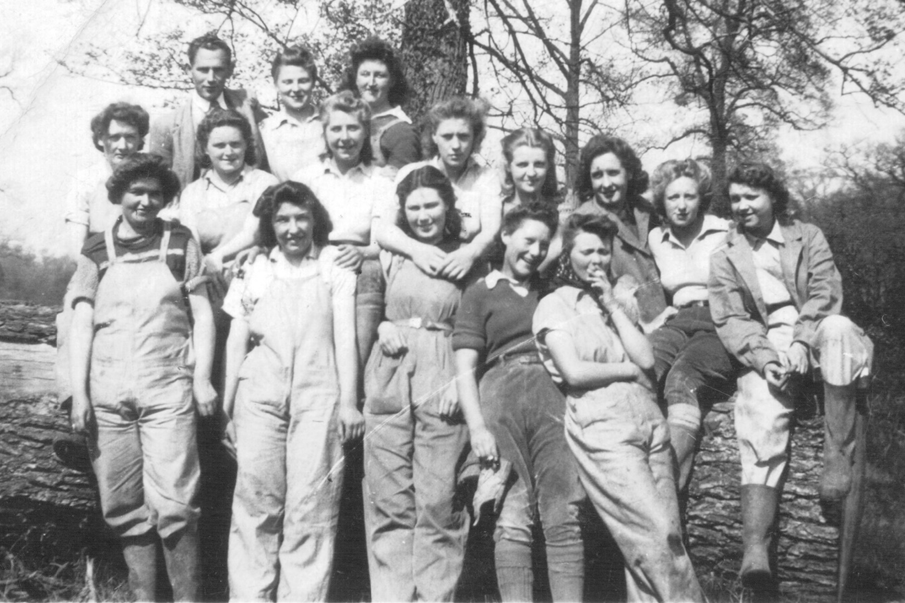
The team of Land Army girls from the North Street Hostel circa 1942, with their manager, Frank Fitch, top far left. Connie is in the centre with her arms around her new best friend Amy May Knibbs (Nibby). Can anybody identify others here? If so, please contact us on https://nazeinghistory.org/contact/
The bikes the girls were given were big and heavy – men’s bikes, with a cross bar, but they were expected to use these to cycle to wherever they were working. They were sent to the commons in Harlow and Latton. The commons were already in cultivation in 1942/3. The girls from Nazeing Hostel would spend the day hoeing or on their hands and knees singling out sugar beet. Connie said: you couldn’t see the ends of the rows and the sun was streaming down. And then you cycled home the seven miles, or so.
We don’t have any pictures of the hostel, but Connie described it: “You walked into the drive and there was a big wooden hut type of building in front of you. There were four dorms, In the middle there was a great big fire, an old-fashioned fire with a big chimney that went out the roof. There were about two or three of them. That’s all we had for warmth. The dorms were only partitioned off. …. We all slept on bunk beds. There were eight girls in each partition. If you came in the door and went the other way you came to the ablutions which included several bath places… only partitioned off, … There wasn’t a lot of privacy. We were full of fun and played tricks on each other, well we had to be or we wouldn’t have had a life otherwise… there was the big room, with the dining room and the kitchen. Also, a small area where the supervisor lived. That’s what we called her. She was single, she wasn’t married. She was very nice. She was a career person, she wasn’t local. They had a local person that did the cooking, who the girls used to really torment”.
The Land Girls at the hostel worked hard and played hard, using their bikes to go to dances in Hoddesdon and beyond. They had to be back before the curfew, but often got back late. Connie had many a tale to tell of their antics. They were just young girls who would have never left home if it weren’t for the war.
By August 1942, the Golf Course on Nazeing Common was being ploughed up. Hundreds of acres of hitherto derelict common land, much of it covered with thistles and anthills, would be in cultivation the following year thanks to the Essex War Agricultural Executive Committee.
The team of girls were awarded the title of “Champion Hedgers and Ditchers”, and this picture appeared in the Daily Telegraph in 1942.
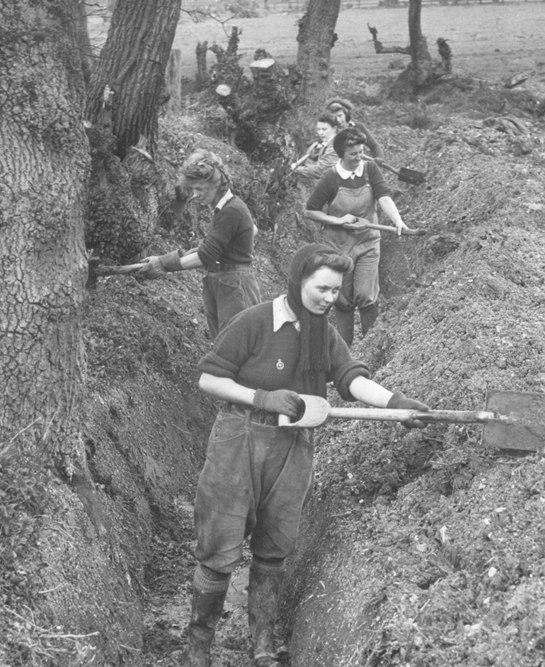
Land Girls from the Nazeing Hostel: from the front “Nibby” Amy May Knibbs, Connie Hale, Eileen Jaycock, ? , Phyllis Charman.
Phyllis Charman from Romford married the foreman, Frank Fitch. Connie Hale also married local boy Dennis Mead, and the two girls remained lifelong friends. As Dennis was still in the RAF Connie lived with Frank and Phyllis Fitch at Farm Cottages, Long Green. They weren’t the only Land Girls to marry local boys.
The 1945 Electoral Register for Nazeing had 32 entries mentioning WLA. Eight in the hostel at the Golf House on Nazeing Common, four at the Princess Louise Convalescence Home in Middle Street and fifteen at the Hostel in North Street. These included Joan C Broughton who after the war married another local boy, Dessie Crow, in 1966.
Prisoners of War
Land Girls weren’t the only visitors to come to the village to help out on the land and in the nurseries. Italian prisoners of war, captured in the Middle East were brought to Britain from July 1941.
Robert Tubby, who lived at Old Sun Cottage, told us “P.O.W.s did farm work around the common, one took a shine to my sister Alison & carved her a wooden doll. The land girls were also popular with the Italian POWs.”
Connie Hale had a wooden carving from an Austrian POW she had worked alongside while working in the later years of the war at Woodredon Farm, in Epping Forest.
A POW from Eastern Germany married a local girl from Back Lane, the couple raised their family and settled in the village.
Three P.O.W.s worked at Langridge Nursery, seen here with Clifford Dick Chapman of Langridge Nursery.
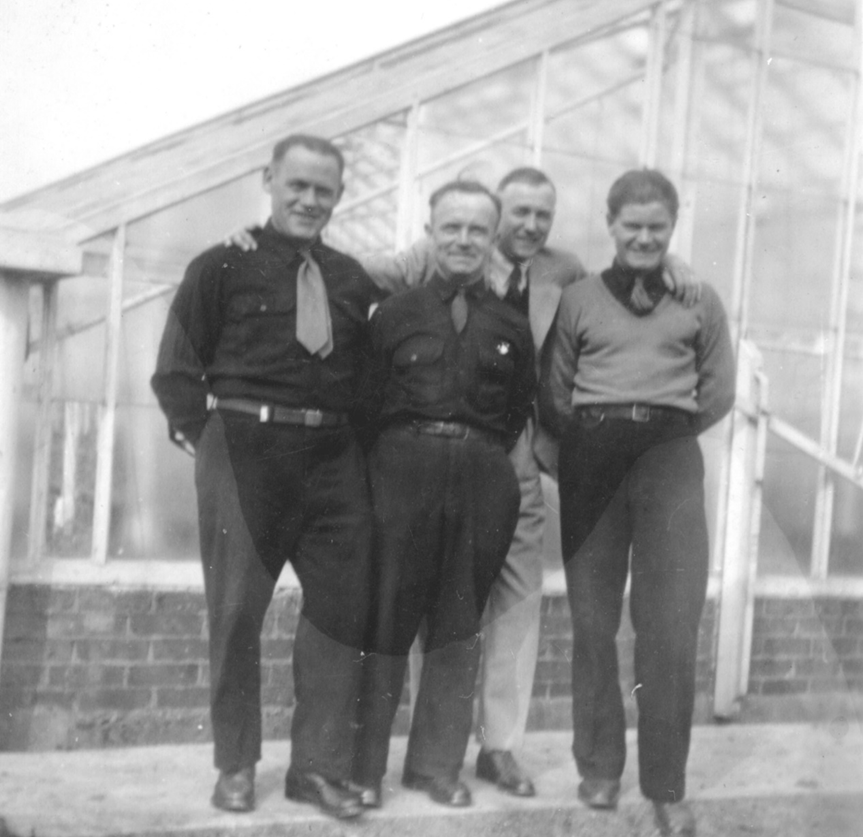
Italian Prisoners of War with C D Chapman (back) at Langridge Nursery
The three POWs slept in a wooden hut on the opposite side of Paynes Lane from the nursery. In their free time they used a small brick building at Langridge Farm, which was the brew house. They carved little wooden animals for Pam Chapman who was the youngest child of Willia Chapman at Langridge Farm. Sadly, none of these carvings have survived. Pam recorded these memories and many more from her family and friends at the farm. Please get in touch if you have stories to tell of war time events in the village? https://nazeinghistory.org/ or https://www.facebook.com/nazeinghistoryworkshop
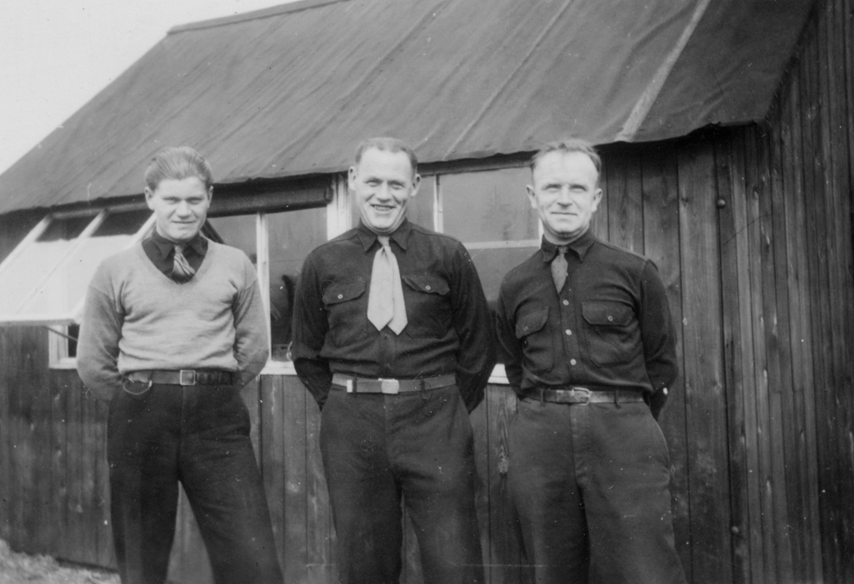
The three POWs working at Langridge Nursery in front of the wooden hut they slept in.
You can read many more stories of events during the war and agriculture during the 20th Century in Seventeen miles from Town – The story of Nazeing, part 2.
Contact us via https://nazeinghistory.org/publications or https://www.facebook.com/nazeinghistoryworkshop for your copy at just £10 + P&P
Our final blog will be about the end of WW2, in the summer of 1945 and how the village celebrated.
 Nazeing History