TWO AERODROMES
The Dummy Airfield: Nazeing Common
A National Heritage scheduled monument – list no. 1020391
An important strategy in the early part of the war was the creation of around 200 decoy airfields, designed to divert the attention of the enemy away from real aerodromes nearby. Apart from the construction costs, several thousand men must have been employed in operating these decoys. K sites were intended to replicate the appearance of a normal operational aerodrome as seen from the air; Q sites were the night-time equivalent, designed to represent the working lights of an airfield after dark. Nazeing Common became one such dummy airfield, which was both a K site and a Q site. It was laid out with dummy aircraft and a flare path, as a decoy for the major operational fighter station at North Weald, four miles to the east. It was protected by a searchlight situated opposite Back Lane, anti-aircraft guns were manned by the Royal Engineers, and a contingent of the Observer Corps.
This O.S. Map below shows (circled in red) the area of Nazeing Common that was the site of the Dummy Airfield.
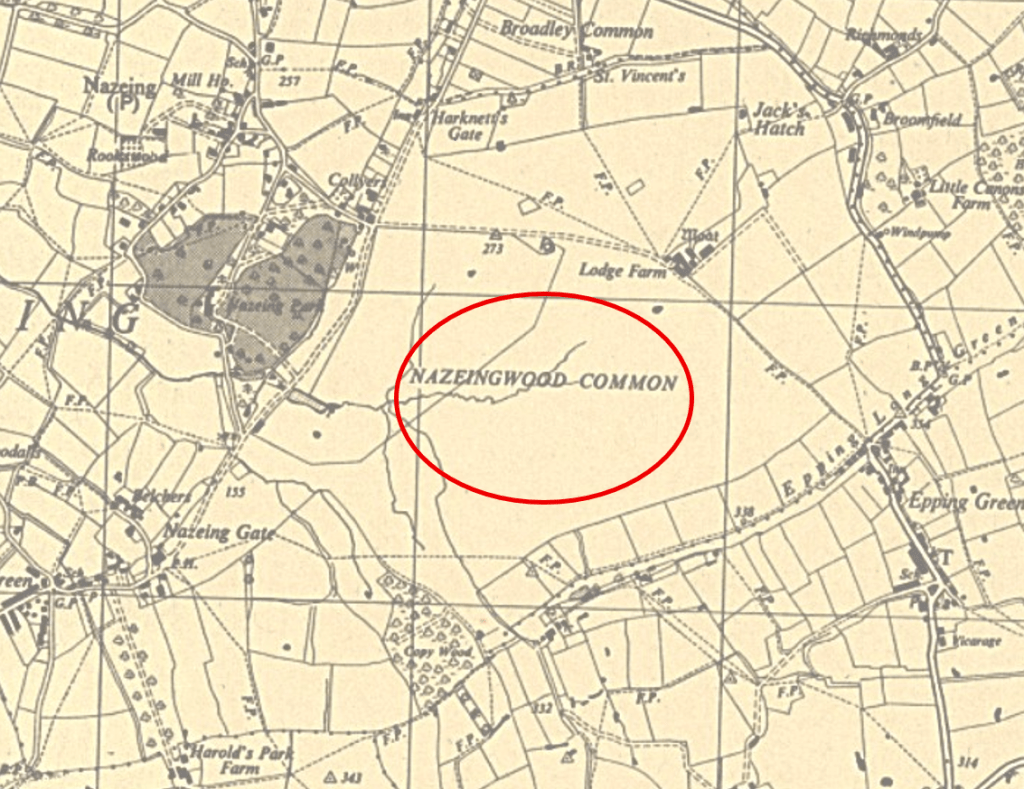
Site of dummy airfield at Nazeing Common
This photo below shows the lie of the land. It was taken from the track from the Duck Pond to Lodge Farm. In the distance, the buildings at the Duck Pond can be seen top right. Nazeing Park Cottage, Back Lane is the white dot in the centre. The houses in Bumbles Green Lane can be seen on the left-hand side. In the foreground, a shallow valley of agricultural land, was occupied by the dummy airfield during WW2. From the air the slope would not have been perceived.
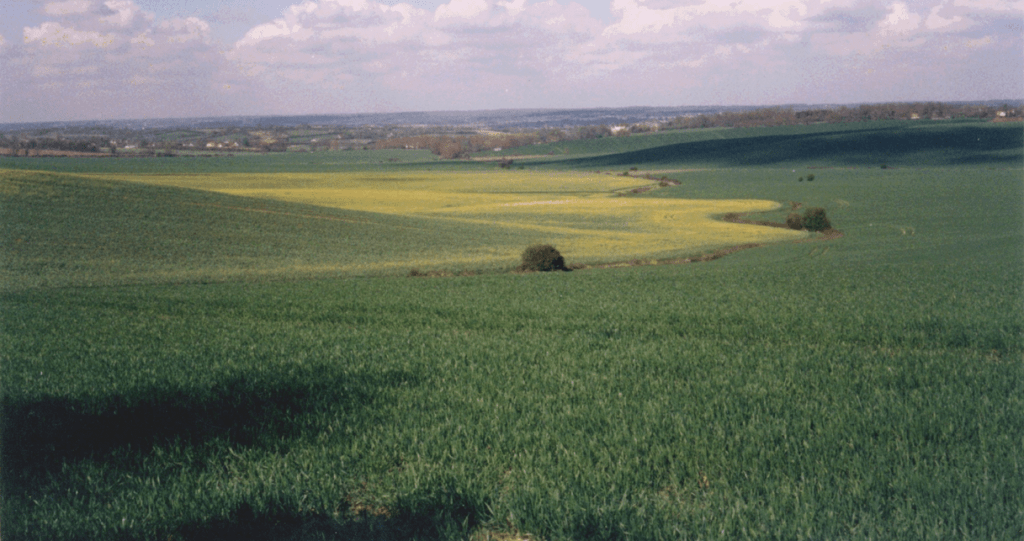
Nazeing Common seen from the track to Lodge Farm
Robert Tubby was a young lad living at Sun Cottage, near Harknet’s Gate at the top of Nazeing Common. He recalled The Common during the war was a dummy airfield, dummy airplanes were moved about, everything was done to mislead the enemy aircraft, to draw them away from the genuine site at North Weald. He also told us a generator for a search light was positioned opposite the Sun Inn, just by the current entrance to the Cricket Club. This can be seen in the photo of Robert on the family horse below. On the horizon on the RHS you can see the Observer Post, situated on the road to Lodge Farm, as well as a few hay ricks. We will tell you about the Observer Corps who occupied the post in a later blog.
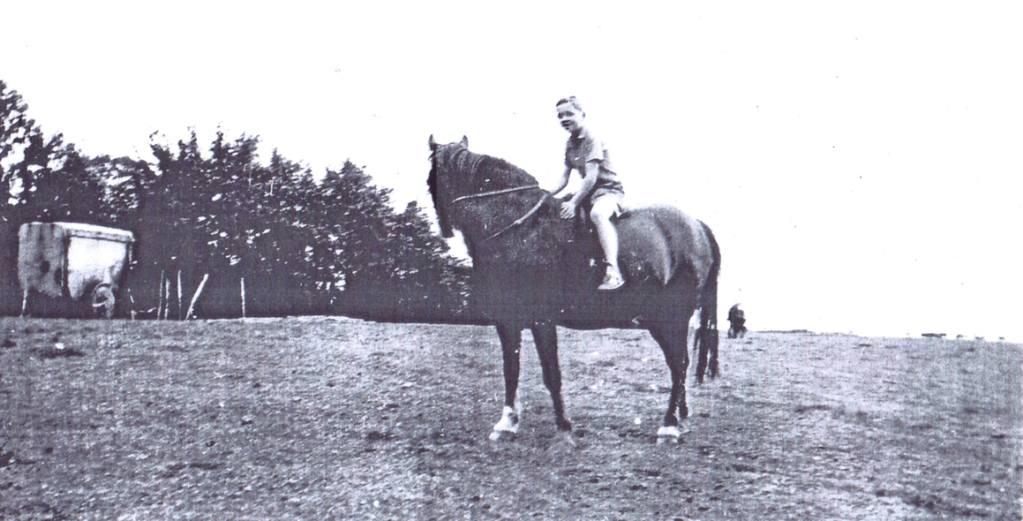
Robert Tubby near The Sun Inn, Nazeing Common
`Q’ site deceptions included runway lighting, obstruction/recognition lights and moving headlamps.
The control bunkers which housed the switchgear, generators and decoy personnel were for safety located some distance away on the hillside overlooking the decoy area. The National Heritage monument includes these night shelters on the high ground which would have given a good view over the area of the decoy airfield. In the past, before the hedgerows had grown up, they were easily seen on the right of the road as you drove uphill from the cascade bridge on the common.
beyondthepoint.co.uk/nazeing-bombing-decoy-bunkers
The northernmost shelter is a substantial building of brick and concrete construction of a standard design known as Type 3395/40. The whole structure is constructed above ground level and is covered by earth. It is a total of 16.5m long and 11m wide. The building itself is entered by a brick passageway on its southern side; to the west is the Operations Room (6m long by 2.8m wide) which has an escape hatch at the far end.
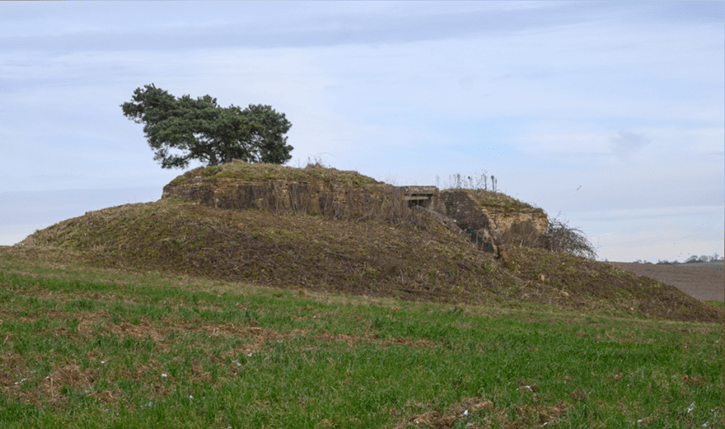
Northern Night Shelter
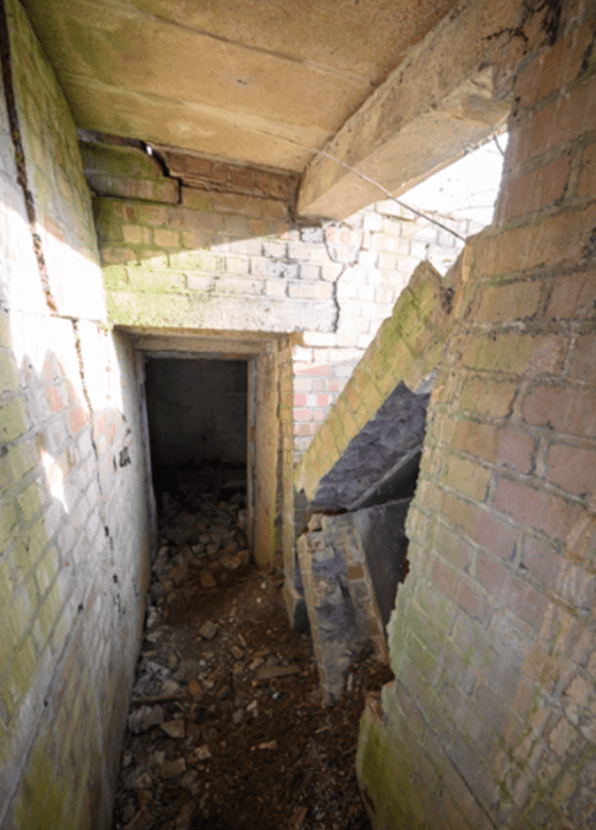
Northern Night shelter access
The northern night shelter features the operations room and engine room, both accessed by the corridor off the entrance. The operations room was equipped with an escape hatch at one end. The engine room would have connected to the pipes outside to pump out the fuel. This shelter was made of brick and concrete above ground and surrounded by earth, and although of very solid construction, the entrance has collapsed – possibly intentionally destructed in a vain attempt to seal the bunker.
The southern night shelter is similar in layout to the northern bunker, and features the operations room and engine room in a similar layout accessed by an entrance corridor. The main differences with this bunker is that it is fully buried underground and made from a relatively thin corrugated iron tube, as well as being slightly smaller. Perhaps this was an earlier less-sturdy bunker, with the northern shelter being added later into the war to supersede it, although the exact reason for there being two shelters of similar design and function is not understood.
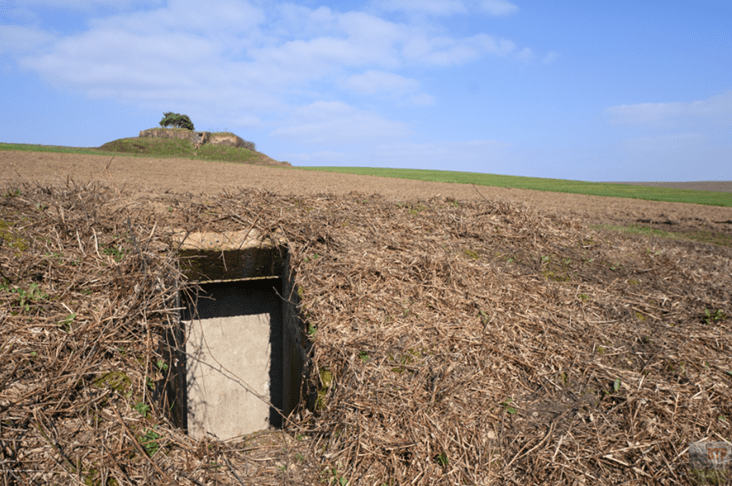
Southern Night Shelter
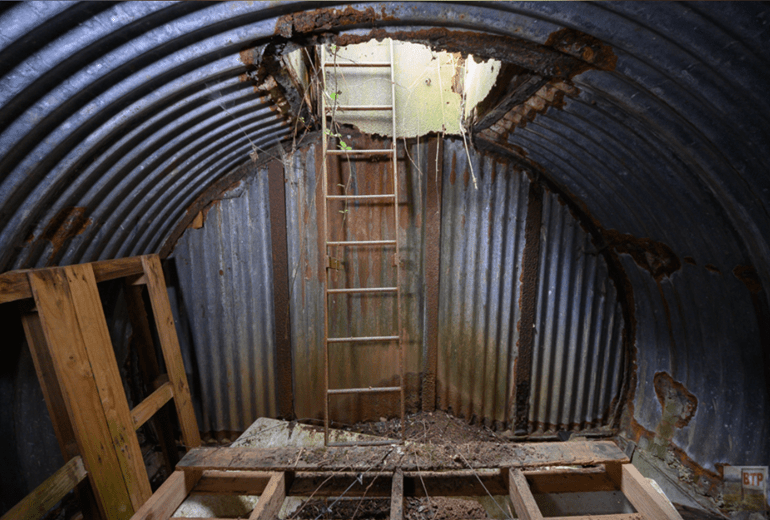
Southern Night Shelter
John Graham, whose father farmed Lodge Farm on the common during WW2 recalled that: The airmen from North Weald used to bring their beacon and flare path when the wind was in a certain direction to distract German bombers from the aerodrome target on to the dummy aerodrome on the Common. One used to stay out on duty with the wireless (R.T.), while the rest used to come in the farmhouse to play cards, or help us boys make our Meccano models or play with our Hornby Trains. Through them we received several extra rations of sugar, tea, etc.
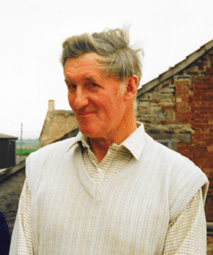
This photo of John Graham was taken in the 1990’s when John was approaching retirement
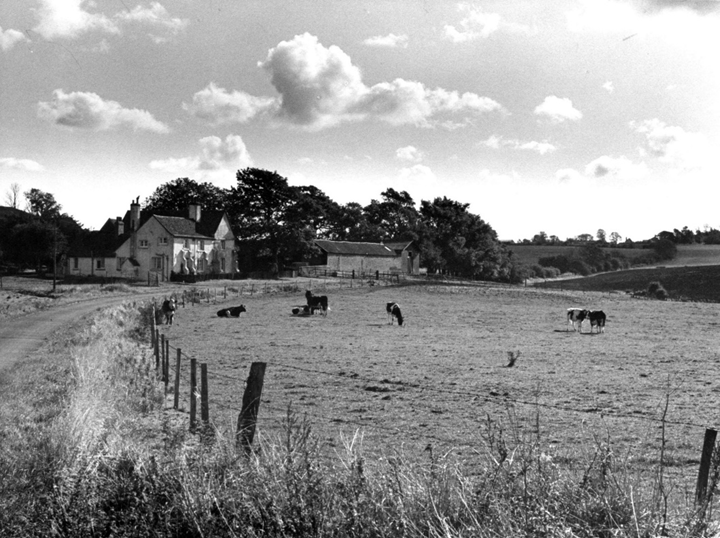
Lodge Farm, Nazeing Common, farmed by David Graham and his three sons during WW2. The Graham family came to Nazeing from Scotland at the end of the 19th Century. Like most of the farms in Nazeing at this time, it was mainly a dairy farm, the milk being sent to London via Broxbourne Station.
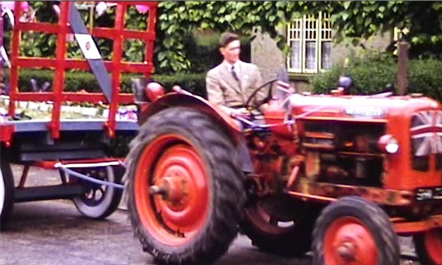
John Graham driving his tractor in the 1953 Coronation Carnival, he was always ready to help out when transport was needed for village events. You can view these amateur cine films on our You Tube channel. https://www.youtube.com/watch?v=q3SnTxzE2k0
The Royal Air Force (RAF) had laid out the same lighting pattern for approach and landing as a conventional airfield, and Les Kimm remembers: seeing plywood Hurricanes and other aircraft dotted around with a few military type huts. The huts housed personnel who would move the aircraft around during the day to make it look more convincing to over-flying German aircraft. Soldiers guarding the dummy airfield lived in huts near the road to Lodge Farm, and one of the officers was billeted with the Grahams at the farm.

Nazeing was equipped with dummy Hurricanes as illustrated here
As elsewhere, the daytime K site was less effective than the night-time Q-site, when plywood planes were lit up. Even so, was so realistic that in late 1940 the Germans dropped fifty high explosive bombs and hundreds of incendiaries in the area. Furthermore, the decoy also deceived the crew of a British bomber aircraft. On 17th May 1940, whilst returning from an operational flight, a Vickers Wellington from 9 Squadron found itself short of fuel and dogged by a thunderstorm as well as by the enemy. Presented with a fully lit flare-path on an unidentified airfield displaying a degree of laxity in the black-out, brought the aircraft down towards the “runway” unaware that it was a decoy.
This and many other stories about the dummy airfield can be found in Seventeen Miles From Town – The Story of Nazeing Part 2. We can post you a copy if you don’t have one, or you can pick one up if you live locally. Only £10 plus £4 postage, you can get in touch via the contacts page on our website: nazeinghistory.org/contact/ or via our facebook page: https://www.facebook.com/nazeinghistoryworkshop
Royal Air Force Personnel were stationed in the barracks on the common, as shown towards the end of our 2nd blog. It was inevitable that some had romantic liaisons with local girls. One of those was Frank Turner. Frances (Frank) Henry Turner came from the West Country and in the summer of 1943 married Anita Mary Mead, daughter of Arthur Mead who was the gardener at Colliers, next to the Duck Pond on Nazeing Common. Anita grew up in and around the common before the family settled in Bumbles Green Lane. After the war Frank and Nita (as she was known) were one of the lucky families to get a new home in Pound Close, where they brought up their boys and stayed for the rest of their married life. Frank was a regular at the Crooked Billet and very involved with the village RAF Association. In the 1980s they could be found helping out at the “Pick your Own” fruit farm in Paynes Lane.
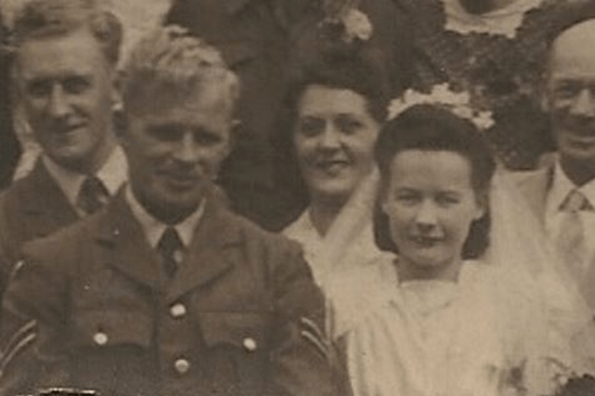
Frank and Nita Turner on their wedding day
The Real Aerodrome
As well as the dummy aerodrome Nazeing had a real one. The Herts & Essex Aero Club airfield, which operated from 1930 to 1953, was one of many converted for wartime use. It was located on the north side of Nazeing New Road, on the site of the present Hillgrove Industrial Estate, and known as Broxbourne Aerodrome due to its close proximity to Broxbourne station. Gravel extraction of this area began in earnest after the war.
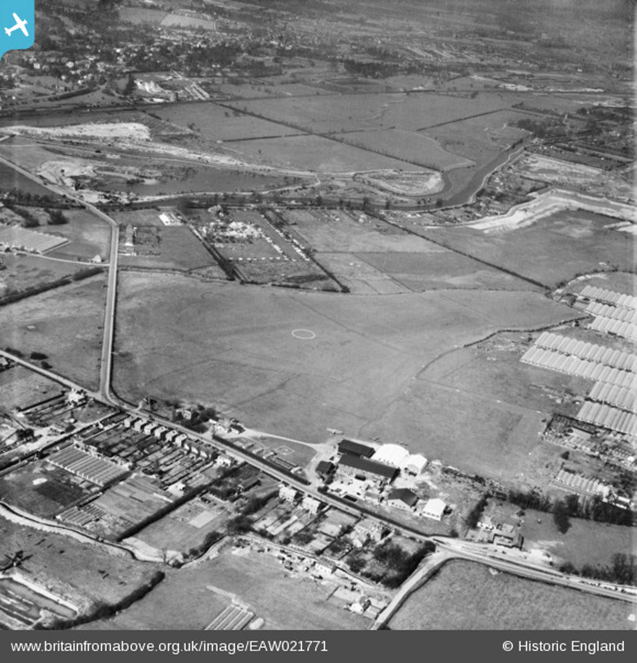
Herts & Essex Aero Club
This aerial photo ( above) clearly shows Nazeing New Road and its junction with Old Nazeing Road, known as Aerodrome Corner by all long-standing Nazeing residents. The relief channel now passes under Nazeing Road at this point. The circle in the centre of the open field denotes the centre of the grass airfield. There are hangers and workshops on the right of the entrance and glass houses situated in Nursery Road on the extreme right of the photo.
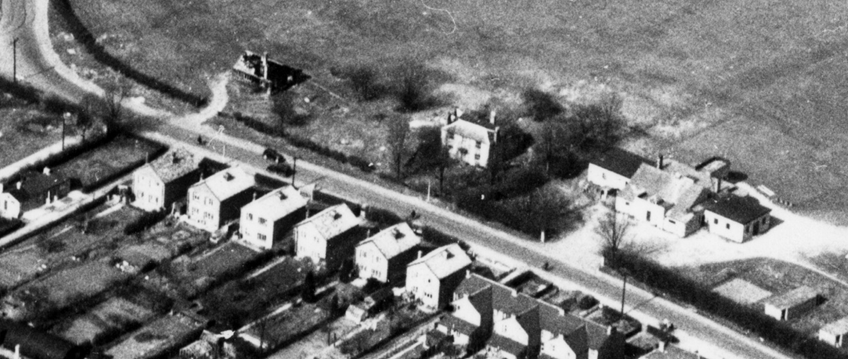
Tatsford House and the Herts & Essex Aero Club House
This enlargement (above) shows Tatsford House, and the small club house at the entrance, which Jacky Cooper (author of this blog) remembers as it hosted the children’s Christmas parties given by the RAF Association before the site closed. Opposite the entrance, on the south side of the road is the row of terraced cottages called Tatsford Villas.

This is a view of the Club house, taken from the direction of the hangers (east), during the 1947 floods.
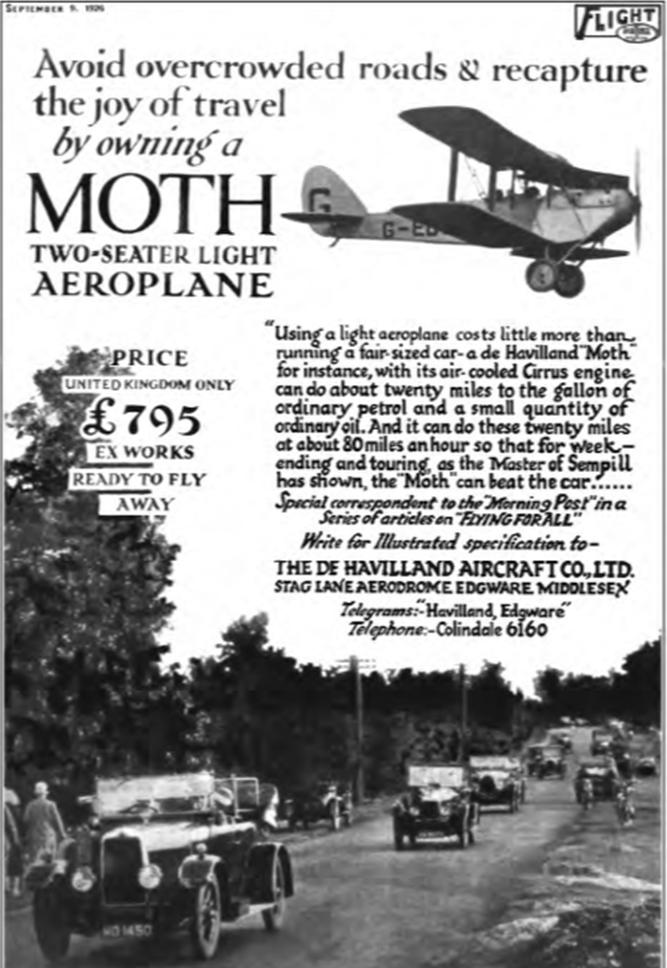
This advertisement in the Flight magazine of September 1926 shows how flying had become popular for the privileged, but few. At that time wages were only £3 a week if you were lucky.
The establishment of the aerodrome began on 13th November 1930
when the Ministry of Civil Aviation granted a licence for flying. The fields there were farmed by Gerard Frogley whose two sons, Arthur (always known as Buster) and Roger, were leading speedway stars who made good money from the sport. The development of the airfield has been well documented in Seventeen Miles from Town – Nazeing Part 2 (https://nazeinghistory.org/contact/ or facebook.com/nazeinghistoryworkshop )
With the approach of war, a Civil Air Guard unit for flying training was established; by the end of 1938 it boasted a fleet of 24 aircraft accompanied by 13 instructors and 50 ground staff. Eventually the Herts & Essex trained up to 400 pilots. Among the pilots was Hetty Frogley, whose guests at the aerodrome included many West End stage personnel, some of whom went on to become ATA pilots delivering aircraft of all types to aerodromes throughout the country. At the outbreak of war in 1939 all private and club aircraft were grounded and many considered not suitable for military purposes were left to rot. Broxbourne was taken over by the Ministry of Air Production and run by the Civil Repair Organisation. It became a repair and maintenance basefor light aircraft. The Aerodrome retained this role throughout the war.
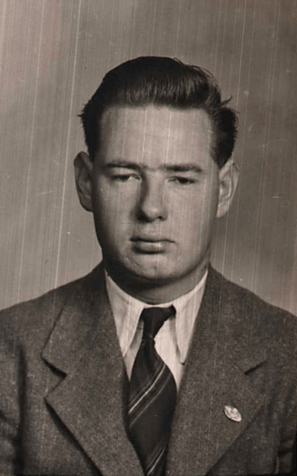
Les Kimm
Leslie Kimm was born in Enfield Highway, Middlesex. The family moved to St Leonards Road, Nazeing, Essex, when he was just a year old. Aeroplanes have always played a major role in his life, from the age of three he was witness to the opening and development of Broxbourne Aerodrome in Nazeing. Aged fourteen he started work at the aerodrome, in the Easter of 1941, and began his career in aviation, working on various types of aircraft, both of wooden and metal construction.
Called up early in 1945, he served for three years as a wireless operator in the Royal Corps of Signals, most of that time in the Middle East.
On release, Leslie returned to Broxbourne as a Ground Engineer with the now re-formed Herts and Essex Aero Club. While there he learnt to fly, and obtained his pilot’s “A”-Licence and Aviator’s Certificate in September, 1948. Later that year he joined the de Havilland Aircraft Company at Hatfield as a Service Engineer on the early jet aircraft, retiring in 1992 after 43 years’ service. His two sons both worked in aviation.
In 2004 Les published two books with a detailed history of the Aerodrome. They were called Wings over Nazeing 1929 to 1945, and Wings over Nazeing 1945 to 1954. They are out of print, but an internet search should locate some second-hand copies.
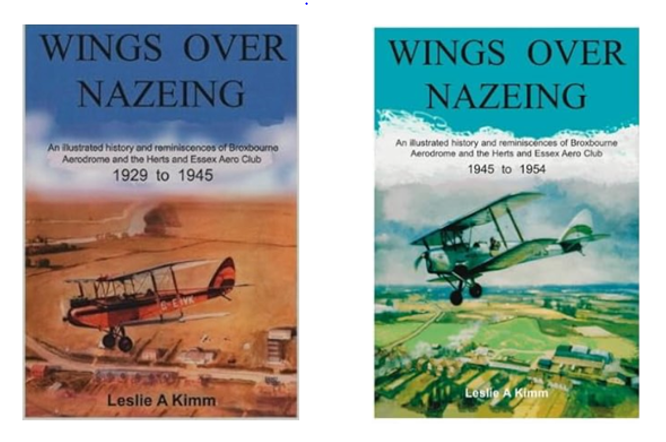
Our next blog will be about the attack from the air.
 Nazeing History